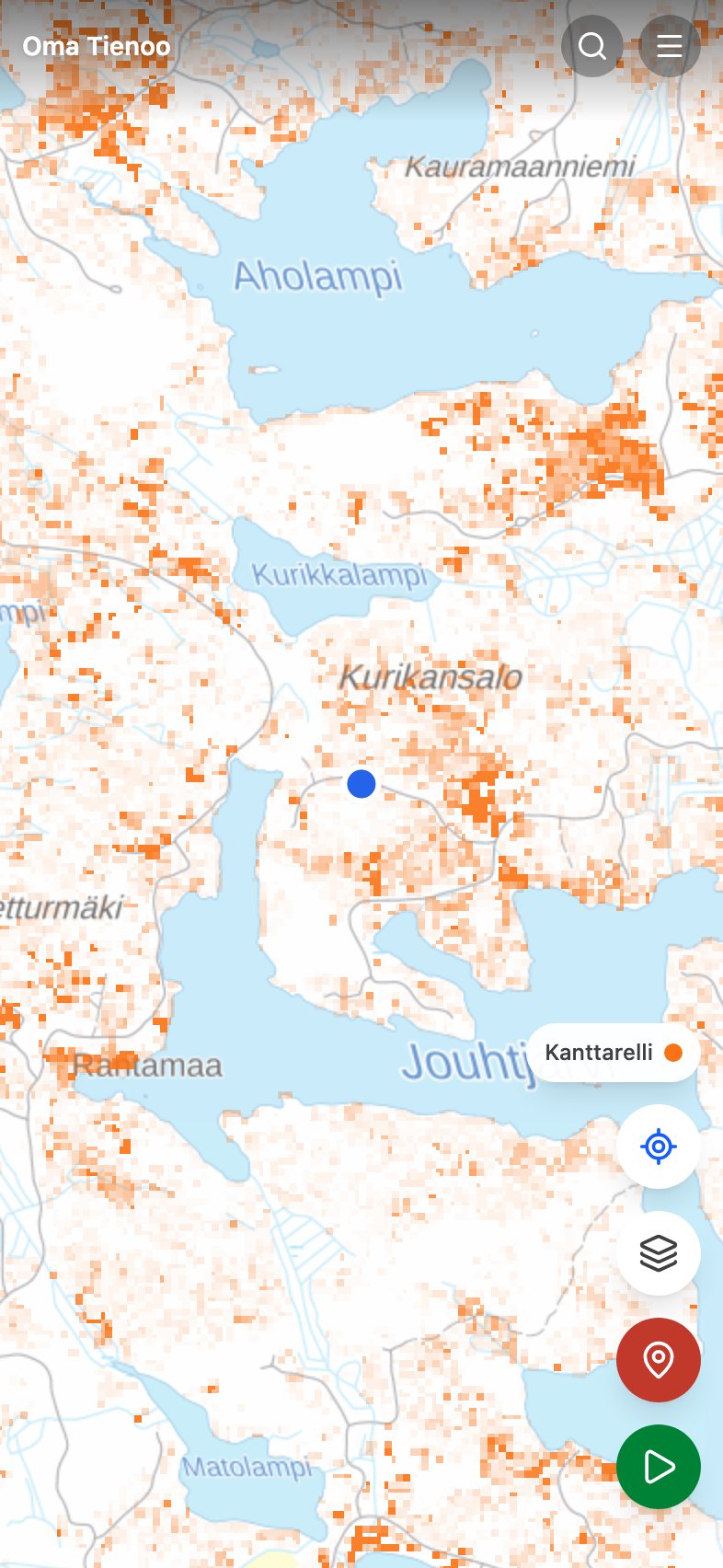
Mushroom maps · prediction
Six species,
six forest types.
The mushroom map colours in, across the whole of Finland, the forest stands where a species thrives. The colour is the same as on the app's map, and the layers can be turned on one at a time or stacked.
- Kanttarelli (chanterelle)
- Birch and other broadleaf on rich ground. Old birch edges stay good year after year.
- Herkkutatti (porcini)
- Mature spruce on lehtomainen kangas (heath forest at its richest), under an open canopy.
- Männynherkkutatti (pine porcini)
- Dry, heathery pine kangas and old, open-grown stands.
- Suppilovahvero (funnel chanterelle)
- Old mossy spruce forest on tuore kangas (moist, mid-grade heath forest).
- Mustatorvisieni (black trumpet)
- Lehto (herb-rich forest): birch and noble broadleaves on the most fertile ground.
- Sikurirousku (curry milkcap)
- Mossy mixed spruce and pine forest on tuore kangas.
The bars say whether a species is worth looking for now in the southern, central or northern part of the country. The division is the Finnish Meteorological Institute's. How the season and the weather are worked out
What the prediction is computed from
The base is the multi-source national forest inventory map data of the Natural Resources Institute Finland (MVMI 2023): tree species shares, kasvupaikka (site type) fertility, mire type, stand age, volume and canopy cover in 16 metre squares for the whole of Finland. Toward the north the prediction is damped according to observation counts from GBIF and Laji.fi. The prediction shows favourable habitat; the yield varies with the weather and the year, so go and see for yourself.
Maps © Maanmittauslaitos · © HSY · © Esri, Maxar, Earthstar Geographics · Mushroom maps © Natural Resources Institute Finland 2023 (MVMI, CC BY 4.0)
The app
What else it does
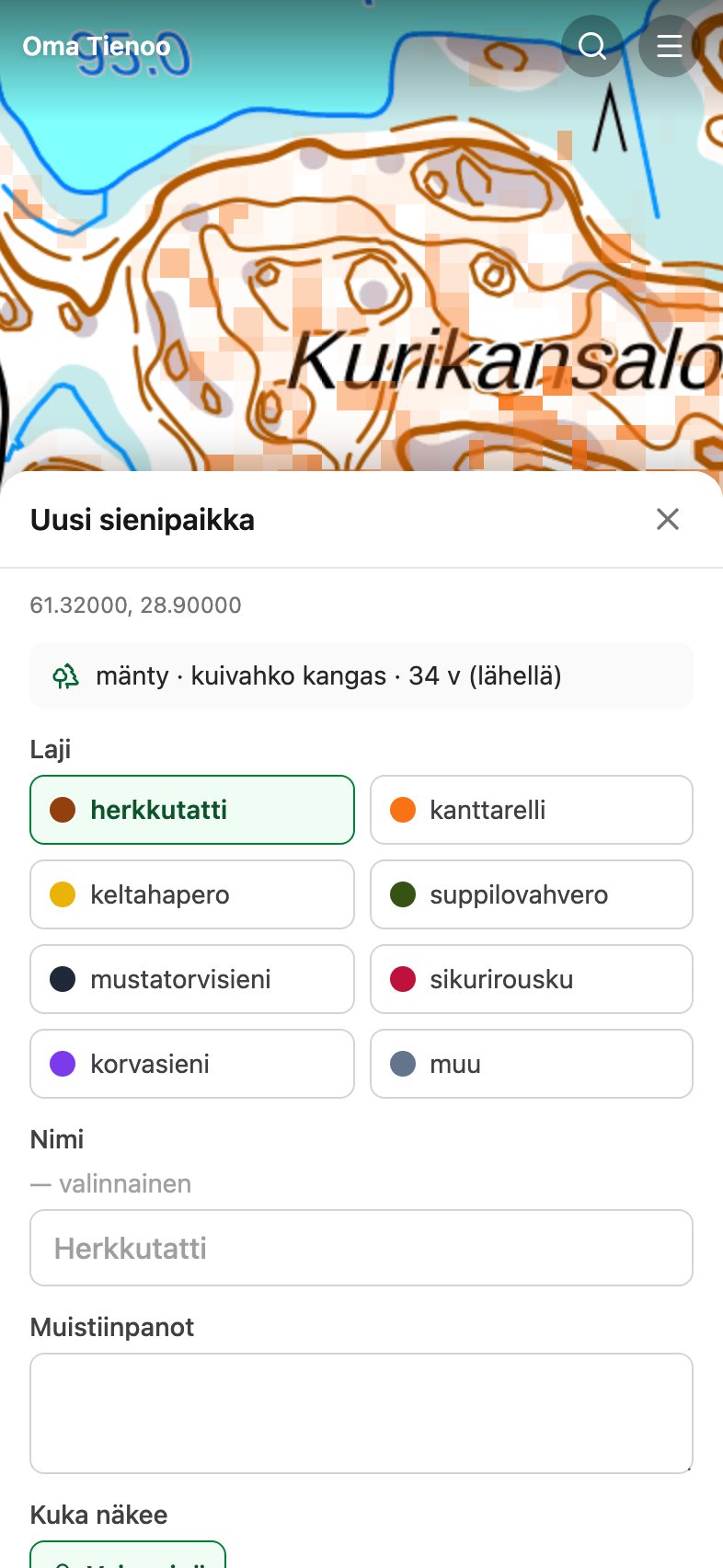
Save your finds
Tap the map, pick the species and forest type. The spot is stored for next autumn.
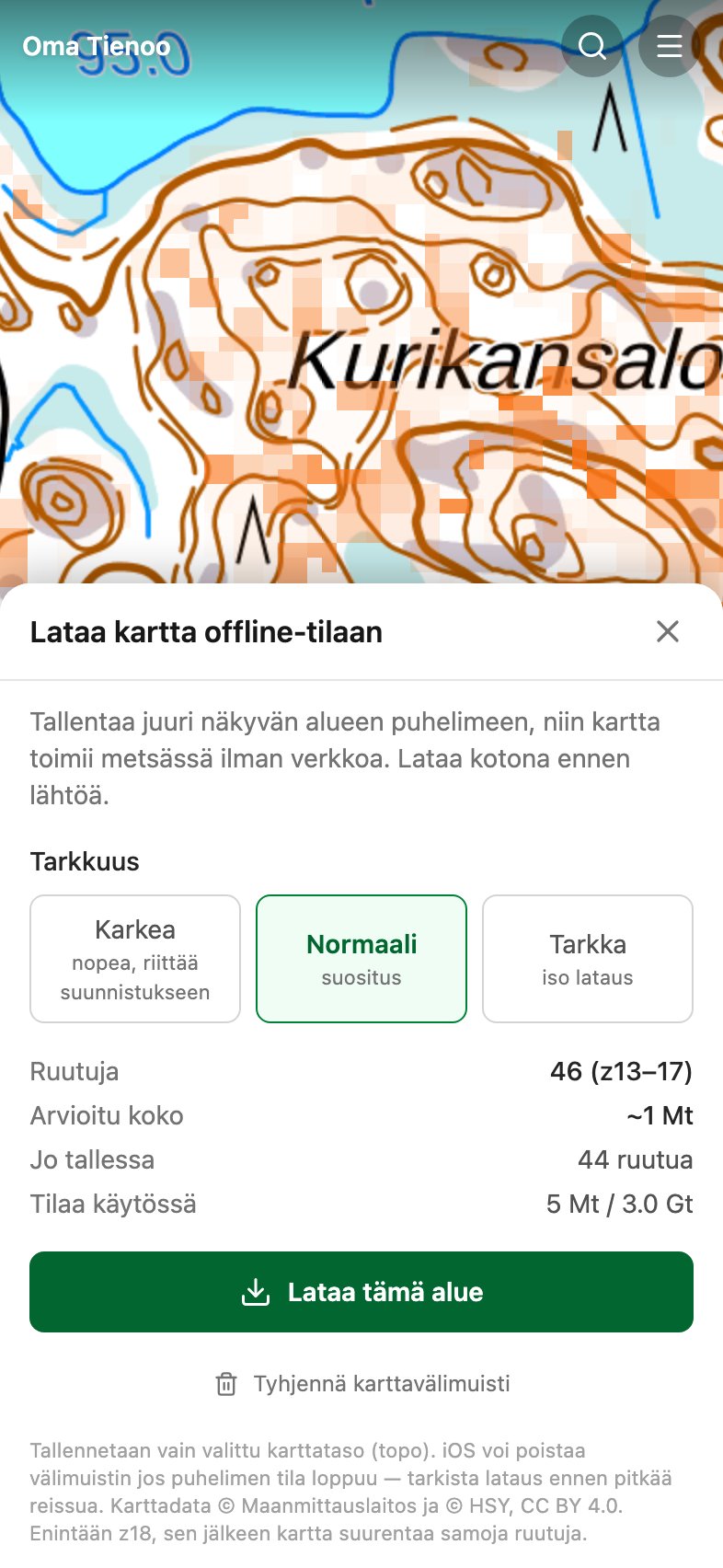
Works without coverage
Download an area in advance: the map, your markings and the track keep working even with no signal.
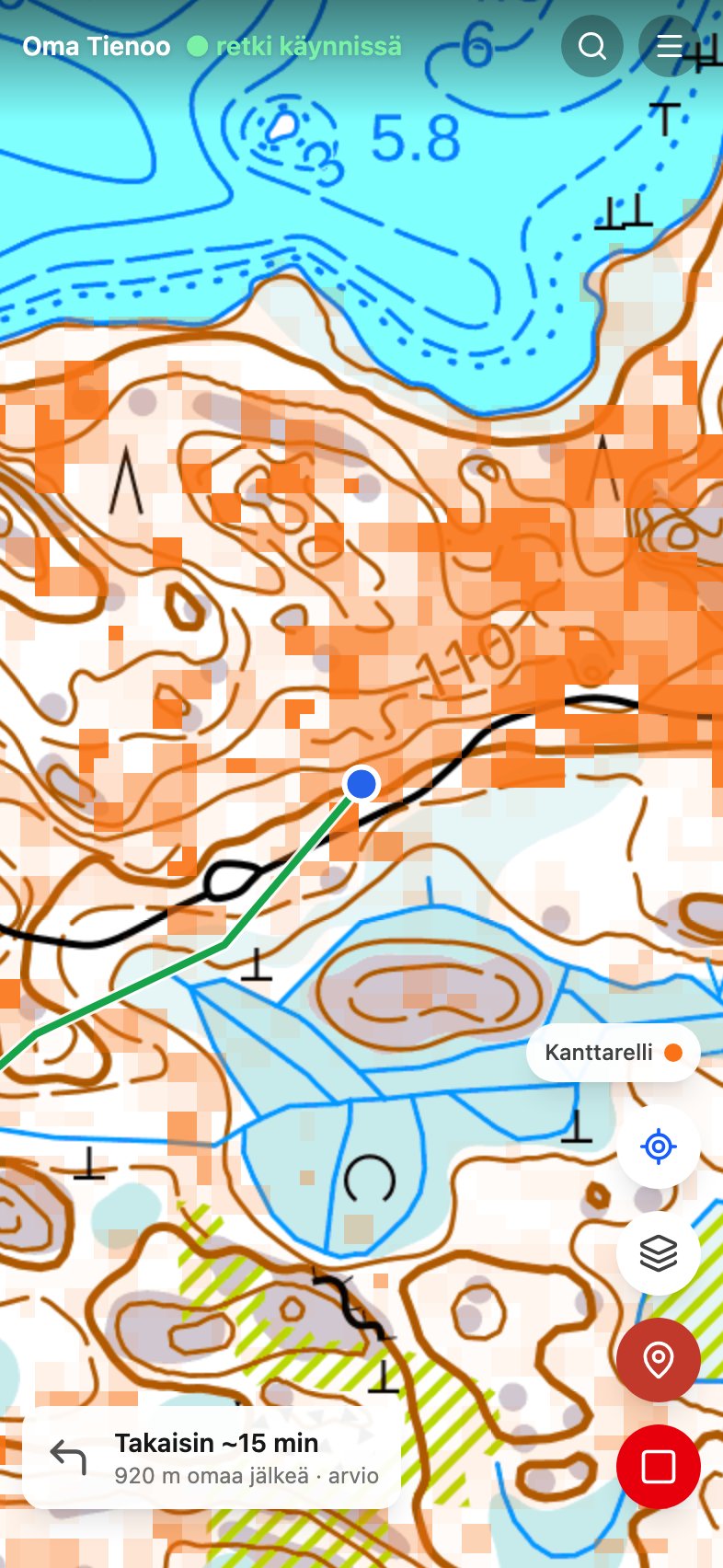
Keep the track
Record the route you walked and see which corner of the forest is still unvisited.
-
Bring your group
You see your group's markings, and out mushrooming you see each other's positions. Sharing is always your own choice, group by group.
-
Upcoming fellings
A map layer shows the stands where a felling has been declared. A mushroom spot rarely disappears for any other reason. How the layer works
-
Find alerts
When someone in your group marks a find, the others get word of it.
Getting started
Three steps to the forest
-
Sign in
With Google or a code sent to your email at oma.tienoo.com. The same door for new and returning users, and there is no password.
-
Activate for a euro
One euro, once. No subscriptions and no further charges, ever.
-
Into the forest
Mark your first spot, or download the map of your home forest before heading out.
Why a euro?
Registration is open to everyone, and the account comes alive with a one-time payment of one euro. The euro's job is to keep automated junk accounts out: a card charge makes mass-producing accounts pointless.
The service's costs are covered by voluntary donations. A donation buys no perks, and the service treats everyone the same.
Payments are handled by Stripe, and half a percent of every payment goes through Stripe Climate to removing carbon from the atmosphere.
Privacy
Who sees your markings
Only you, until you invite someone.
- A new account
- You see only your own markings, and nobody else sees them.
- Sharing
- Happens by invitation, group by group, and the choice is always yours.
- Lists
- No view reveals where anyone forages.
- Tracking
- No ads and no third-party tracking, in the app or on this site.