Mushroom maps · prediction
Funnel chanterelle map
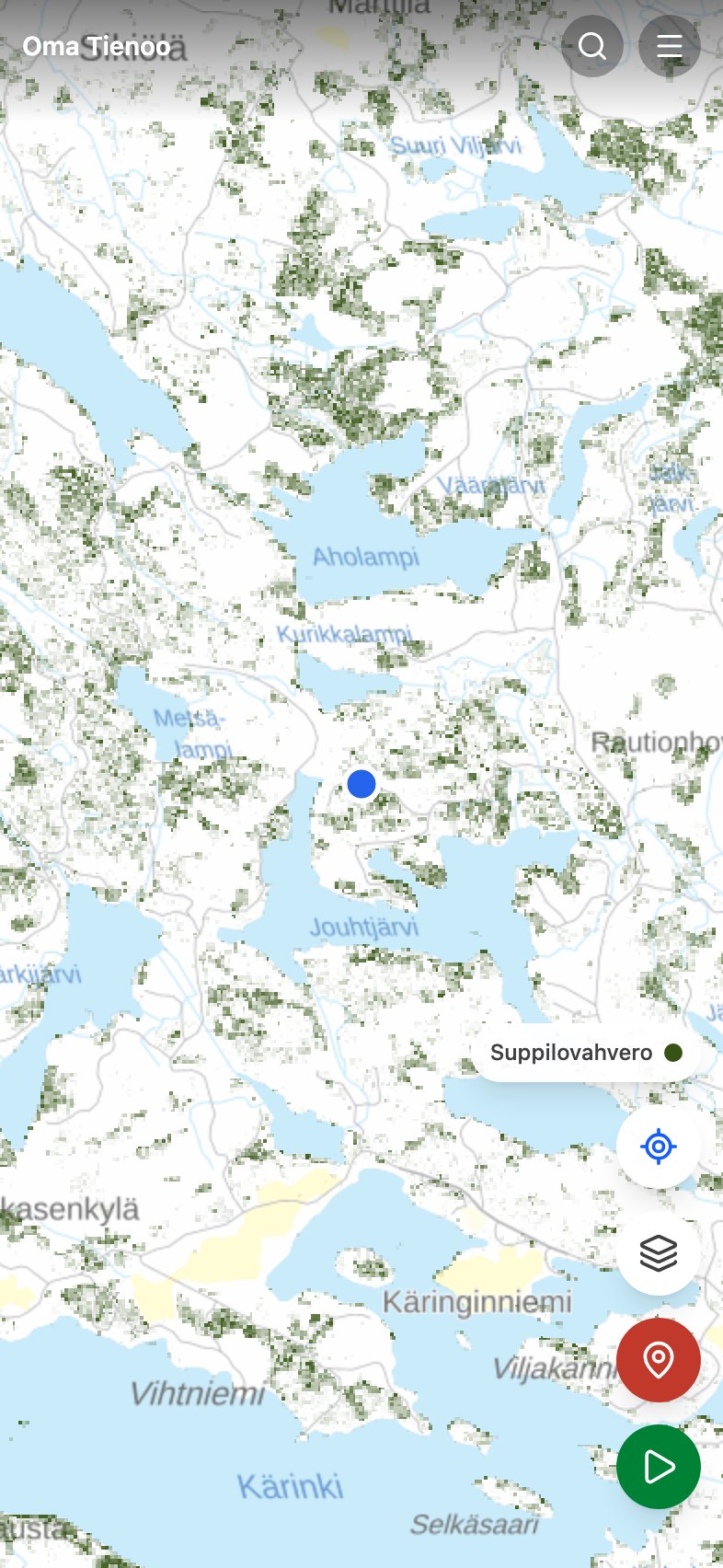
Suppilovahvero, the funnel chanterelle (Craterellus tubaeformis), is an autumn species: it seeks old, mossy spruce forest on tuore kangas (mesic heath forest) and keeps fruiting late, until the permanent snow.
The map does not claim mushrooms are growing here right now. It colors, across the whole country, the forest stands where the funnel chanterelle thrives, in other words where it is worth walking. The weather decides the harvest, and the app now says so: Painota sään ja kauden mukaan dims the layer where the species is out of season or where the rain has not come. The color still means terrain, not a crop.
What kind of forest the funnel chanterelle seeks
- Trees
- Grows in mossy spruce stands, and some pine in the mix is fine. Broadleaf-dominated forest is not its place.
- Site type
- Tuore kangas is best, lehtomainen kangas (rich heath forest) good, kuivahko kangas (dryish heath forest) at half strength.
- Ground
- Kangasmaa (mineral-soil forest), but a korpi (spruce mire) suits it better than any other of the six species: a spruce-filled korpi is genuine funnel chanterelle terrain.
- Stand age
- From about 65 years up, best between 65 and 150.
- Season
- September to November, until the snow comes.
- Northern limit
- The prediction declines after latitude 63.5 and at 67 is under a tenth of the southern level.
The bars say whether a species is worth looking for now in the southern, central or northern part of the country. The division is the Finnish Meteorological Institute's. How the season and the weather are worked out
How to read it
Look for moss-covered, shady old spruce forest and hollows. The species grows in dense groups: finding one usually means dozens, so mark the whole patch rather than a single mushroom.
Identification and cooking notes: suppilovahvero at Martat (in Finnish).
What the prediction is computed from
The base is the multi-source national forest inventory map data (MVMI 2023) from Natural Resources Institute Finland: tree species shares, site fertility, mire type, stand age, volume and canopy cover in 16-meter cells across the whole country. Each row above is one factor in the model, and the factors are multiplied together, so one clearly wrong factor is enough to zero out a cell. Toward the north the prediction is damped according to observation counts from GBIF and Laji.fi, so that sparse recording in the north does not read as the species being absent. More: the mushroom maps and their limits.